
Loading HoneyMesh...
Loading HoneyMesh...
Paid Firewall Beta, Node Pro, and Infrastructure Pro customers can verify their billing email for a signed, plan-matched host archive. Node Guard Free is available through npm.
Standalone Firewall Beta, Node Pro, and Infrastructure Pro each have a paid, plan-matched archive. Verify the email on your Stripe receipt, download the matching archive, and use its included signed manifest, publisher key, installation guide, and recovery guide. Node Pro and Infrastructure Pro include Firewall Beta for licensed hosts without another Firewall charge.
Historical RC4 customer packages are withdrawn. Do not install them from old copies or use their manifests to verify current archives.
These records are retained for version history; package files are no longer public downloads. The candidate passed Debian and RPM install and removal drills in isolated systemd containers; a Debian upgrade from rc2 preserved node state and certificates. The three-node federation proof was measured on rc2, not rerun on rc3. A fresh VM and packet-level rc3 acceptance test remained open. ARM64 was not built for rc3.
2.3.6-rc3 AMD64 (.deb)
Release candidate for compatible Debian and Ubuntu x86-64 hosts.
Package archived; public download closed.
2.3.6-rc3 AMD64 (.rpm)
Release candidate for compatible x86-64 RPM hosts.
Package archived; public download closed.
2.3.6-rc3 AMD64 (.tar.gz)
Release candidate archive for manual installation on x86-64 Linux.
Package archived; public download closed.
Core Beta · paid subscription
Node Guard Free is available separately without payment. Infrastructure Pro customers can verify their billing email and download the signed Core and Firewall archive for their licensed hosts.
Infrastructure Pro · paid beta pilot
$15 per five-node block each month for signed local Core licenses on up to five noncritical Linux hosts. Distributed Pro capabilities remain outside the supported pilot scope while qualification continues.
Trusted Network Sharing stays off in this pilot.
The local-only profile is configurable by an administrator, so keep Exchange and trusted sharing disabled during the Core Beta and paid pilot. A paid license does not qualify distributed enforcement for production use.
Exchange discovery is a separate Pro workstream
HoneyMesh admins can choose whether to discover networks, review cluster IDs, and set trust for a future distributed deployment. That workflow is not part of the current Core Beta evaluation.
The Pro design lets admins discover candidate networks and review cluster IDs, then decide what to trust before another network affects local enforcement. This distributed path remains under qualification.
1. Opt In
Enable exchange participation from inside the app when you want discovery and shared attack intelligence.
2. Review Cluster IDs
HoneyMesh shows observed cluster IDs so admins can decide which outside networks belong in the trusted mesh.
3. Set Trust
Assign L0 through L3 trust and use temporary tokens to join only the networks you explicitly approve.
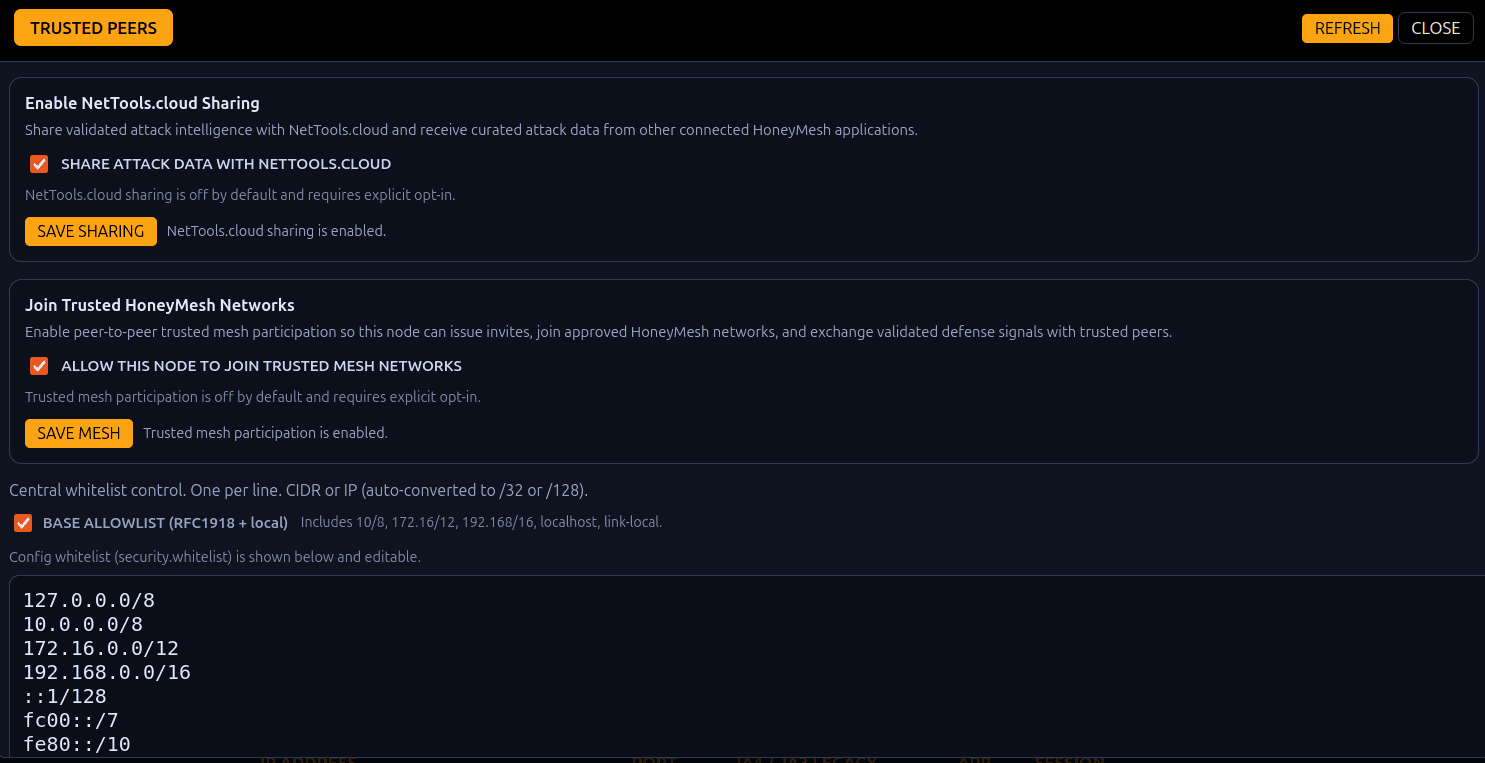
The app shows exchange connection state, cluster IDs, and trusted mesh network controls in one place.
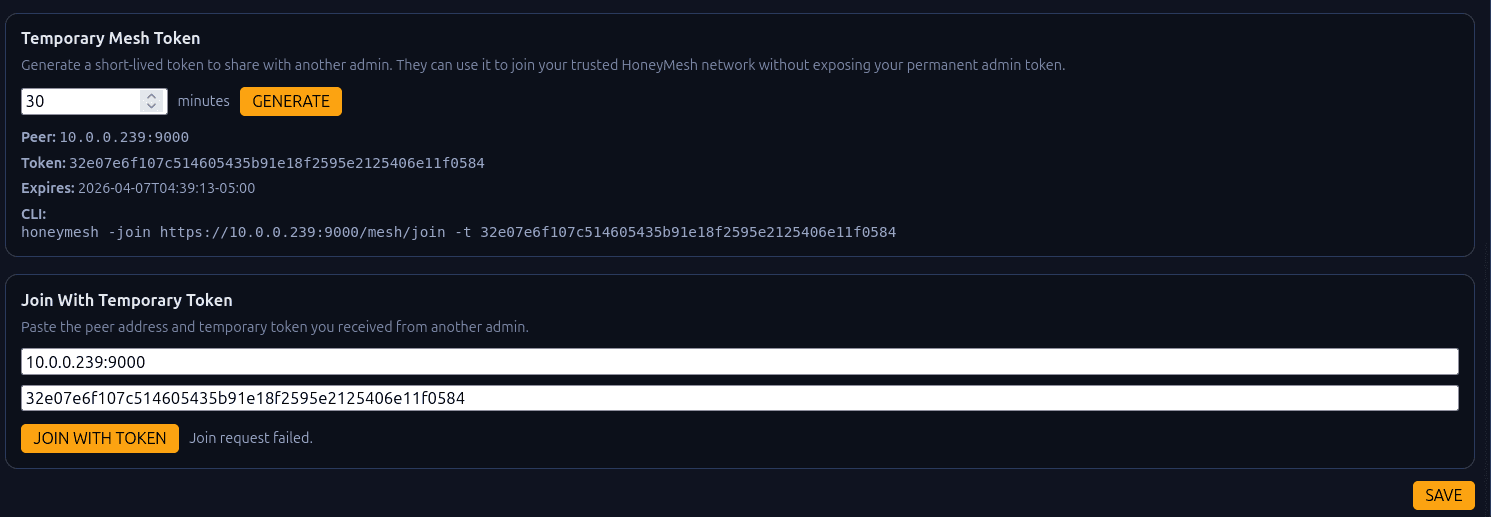
Temporary tokens let admins connect approved networks without exposing permanent admin credentials.
Public documentation explains operator workflow, product boundaries, and the intended sharing model without publishing sensitive detection logic or attacker-useful implementation detail.
Customer Setup, Test, and Deployment Checklist
Choose the Linux or Node pilot path, verify the artifact, run a bounded canary, and record rollback evidence.
Historical Client Quickstart (v2.3.6-rc3)
Historical setup and rollback instructions for the RC3 candidate.
Operator Manual (rc2 controls)
Historical control reference for an earlier release.
HoneyMesh 2.3.6-rc3 AMD64 checksums
SHA-256 hashes for three historical RC3 AMD64 packages.
2.3.6-rc3 Release Notes
Package removal fix, tested host matrix, and remaining limits.
HoneyMesh Node Design-Partner Pilot Guide
Application-only Node Guard setup and the current agent-bridge pilot boundary.
Trusted Threat Intelligence Exchange Manual
Portal onboarding, Pro-only Exchange access, node enrollment, sharing controls, and operator workflows.
Architecture Deep Dive
How local protection, JA4 fingerprinting, and Trusted Network Sharing work.
eBPF Security Audit Report
Kernel-path audit summary for the HoneyMesh enforcement layer.
Required publication files for open-source components, including eBPF source scope and generated artifacts.
Shared scope:
• bpf/main.c
• All files within the bpf/ directory
• Generated artifacts that embed or derive from eBPF code, such as `bpf_*.go` and `bpf_*.o`