
How HoneyMesh Protects Against Common Attack Vectors (Expanded)
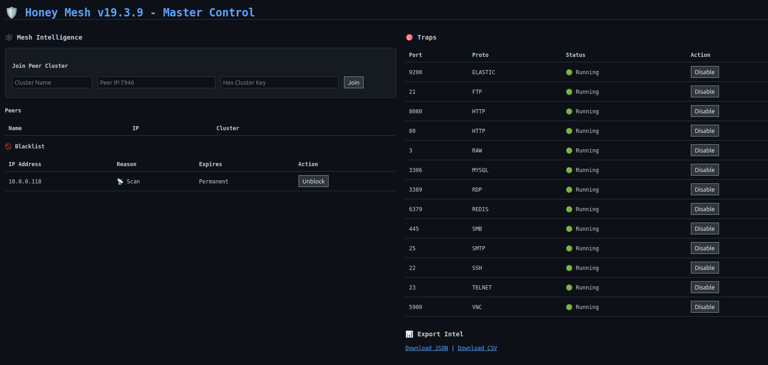
HoneyMesh v19.3.9 disrupts threats across the cyber kill chain by luring attackers, detecting anomalies early, and enforcing blocks at kernel speed—while coordinating via a resilient decentralized mesh.
Below is an expanded list of key attack vectors and how HoneyMesh counters them.
Reconnaissance & Scanning
Probing ports, services, or vulnerabilities to map targets.
Protection:
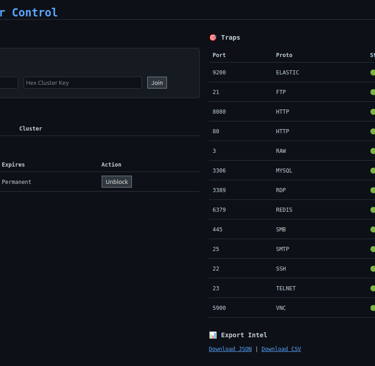
- Traps on common ports capture probes.
- Kernel SYN tracking + thresholding detects scans (≥3 ports/IP).
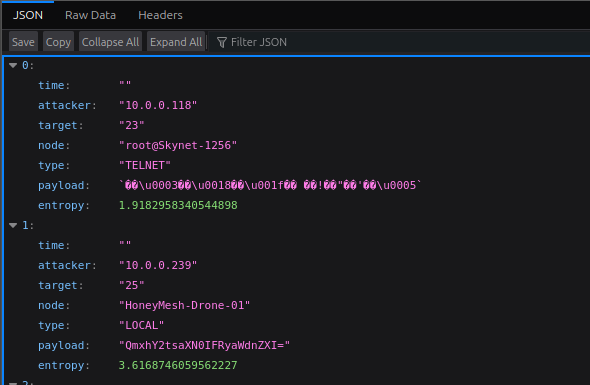
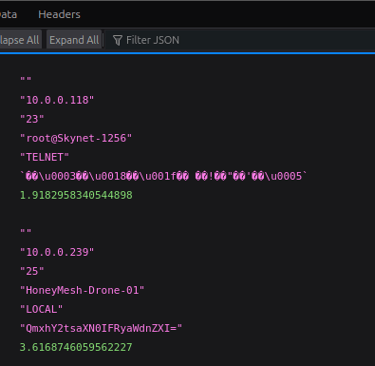
- Entropy scoring flags scripted tools.
- Instant kernel ban + mesh share.
Result: Recon halted before completion.
Brute Force & Credential Stuffing
Repeated login attempts or sprayed credentials.
Protection:
- Decoy services absorb attacks harmlessly.
- High-entropy payloads trigger bans.
- XDP blocks source IP across all ports.
- Federated propagation protects peers.
Result: Attackers locked out fleet-wide.
Distributed Denial of Service (DDoS)
Floods to overwhelm availability, often preceded by scans.
Protection:
- Early detection bans bot controllers.
- Silent XDP drops at line rate.
- No responses starve amplification.
- TTL + mesh limits C2 impact.
Result: Minimal resource use during floods.
Command & Control (C2) & Beaconing
Compromised hosts phone home.
Protection:
- Traps capture initial connections.
- Patterned/high-entropy traffic banned.
- Kernel blocks persistent channels.
- Mesh shares C2 IPs proactively.
Result: C2 severed; lateral movement stopped.
Data Exfiltration & Ransomware
Post-compromise data theft or encryption.
Protection:
- Pre-exploit blocking prevents foothold.
- Outbound pattern detection (if traps configured).
- Kernel stops C2/upload channels.
- Logs + entropy for forensics.
Result: Exfil/ransomware halted early.
Exploit Attempts & Zero-Days
Direct vulnerability exploitation (e.g., Log4Shell-style).
Protection:
- Traps mimic vulnerable services to absorb exploits.
- Payload entropy + immediate ban.
- No real services exposed on trap ports.
- Mesh alerts on new vectors.
Result: Exploits wasted on decoys.
Supply Chain & Watering Hole Attacks
Compromised dependencies or trusted sites redirect to malice.
Protection:
- Traps detect redirects/probes from trusted IPs behaving badly.
- Entropy flags obfuscated payloads.
- Kernel bans malicious sources.
- Advisory mesh avoids amplifying false positives.
Result: Indirect attacks neutralized.
Insider Threats & Compromised Nodes
Malicious internal actor or breached peer.
Protection:
- Advisory mesh: Suggestions TTL-limited; cannot override local.
- Origin tagging + rate limiting detects abuse.
- Manual global unblock for remediation.
- Seccomp + minimal privileges limit damage.
Result: Containment without cascade failure.
Advanced Persistent Threats (APTs)
Long-term, stealthy campaigns.
Protection:
- Low-and-slow scan detection over time windows.
- Entropy reveals obfuscation.
- Persistent logging for anomaly correlation.
- Decentralized design survives targeted takedowns.
Result: Early signals disrupt persistence.
Mesh-Specific Attacks (Poisoning/Flooding)
Target the federation itself.
Protection:
- Rate limiting + TTL bound malicious suggestions.
- Encrypted, isolated clusters.
- Global unblock overrides poisoning.
- Bounded resources prevent exhaustion.
Result: Mesh remains resilient and trustworthy.
HoneyMesh focuses on pre-exploit disruption—turning attackers' initial steps into their defeat through deception, speed, and coordination. By stopping threats at reconnaissance, it prevents escalation across the entire kill chain. 🛡️
Contact
Phone
Admin@network-decode.com
+1-708-665-7344
© 2025. All rights reserved.