
See which nodes need attention
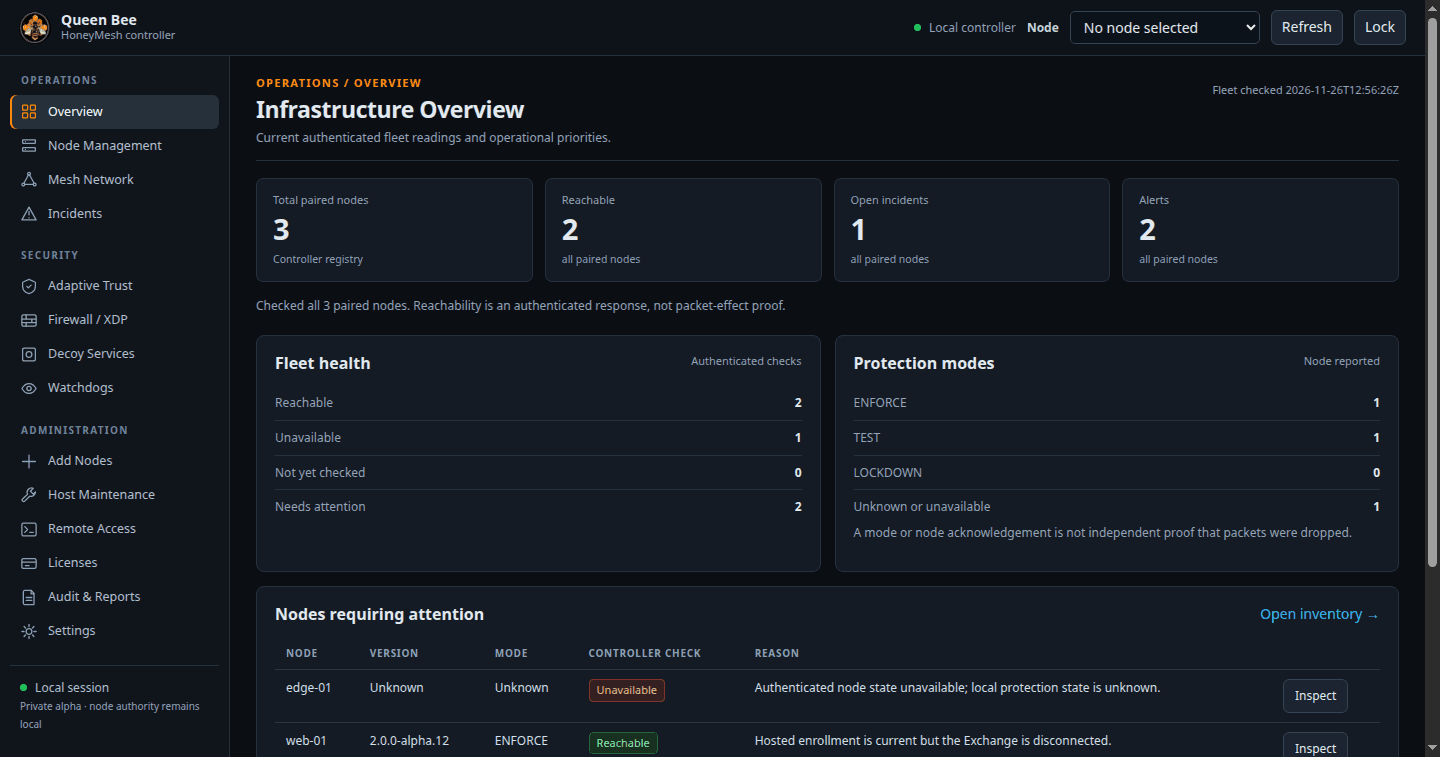
Refresh authenticated node state to compare reachability, operating mode, XDP attachment, incidents, license state, and Exchange connectivity.
A reachable node is an authenticated response, not packet-drop proof.
Loading HoneyMesh...
HoneyMesh / Queen Bee / Private alpha
Included with a HoneyMesh 2.0 purchase. The signed Queen Bee alpha.14 admin pack is available through the private buyer portal at no additional charge after payment verification. Each managed node needs its own signed license. Community and Hosted Exchange membership alone do not include it.
Queen Bee is the separate admin console for licensed HoneyMesh 2.0 nodes. Find the host that needs attention, investigate an exact peer, and take a reviewed action from one private workspace.
Alpha.14 is a private, noncritical evaluation release for Linux AMD64 admin workstations and Ubuntu 24.04 AMD64 nodes. Queen Bee is not a production-qualified fleet manager or a public download.
What an admin can do
The controller collects authenticated node state and presents scoped workflows. Nodes still enforce their own policies and keep working when Queen Bee is offline.
Refresh authenticated node state to compare reachability, operating mode, XDP attachment, incidents, license state, and Exchange connectivity.
A reachable node is an authenticated response, not packet-drop proof.
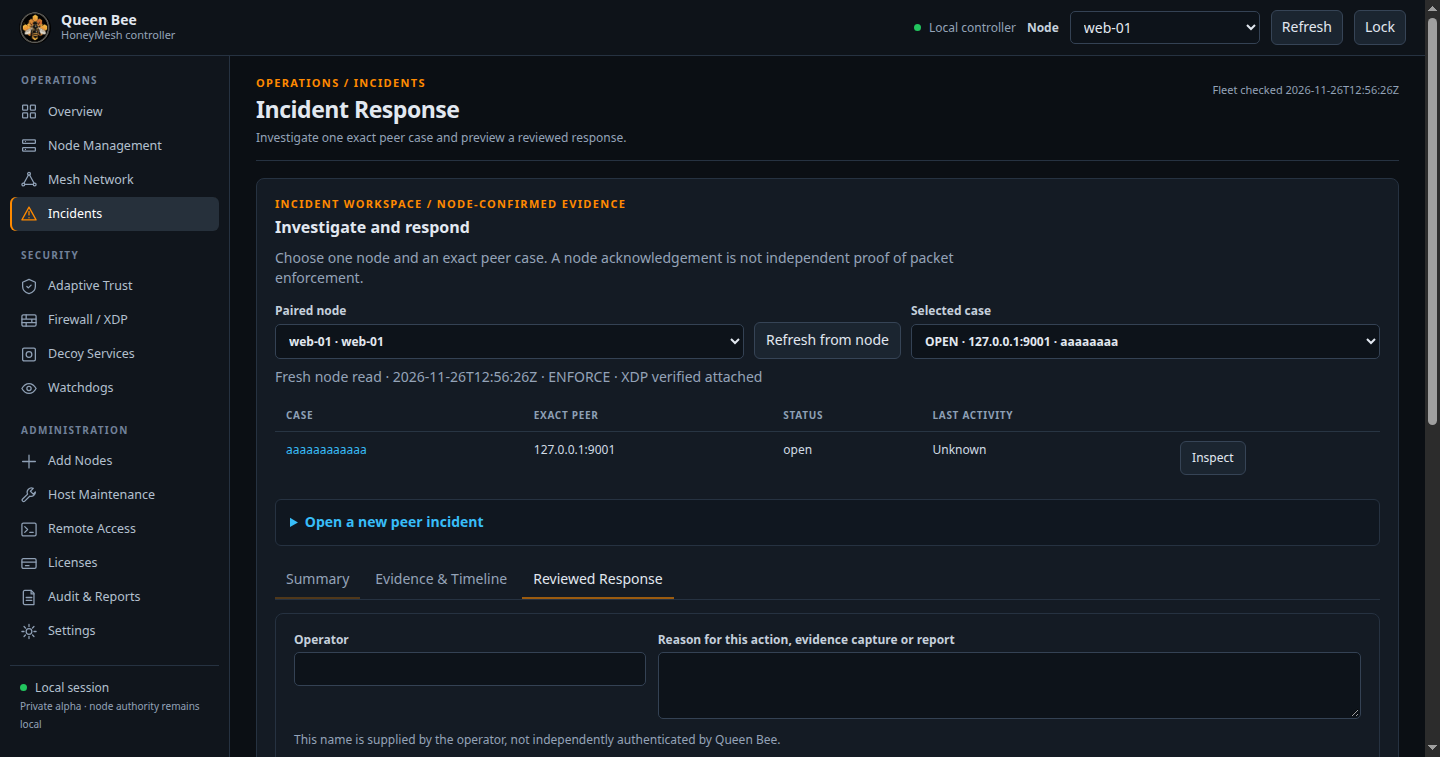
Inspect a case and peer certificate, review holds and rule ownership, preview a scoped action, then read the node state back after applying it.
Two-minute, one-use previews keep the target and effect explicit.
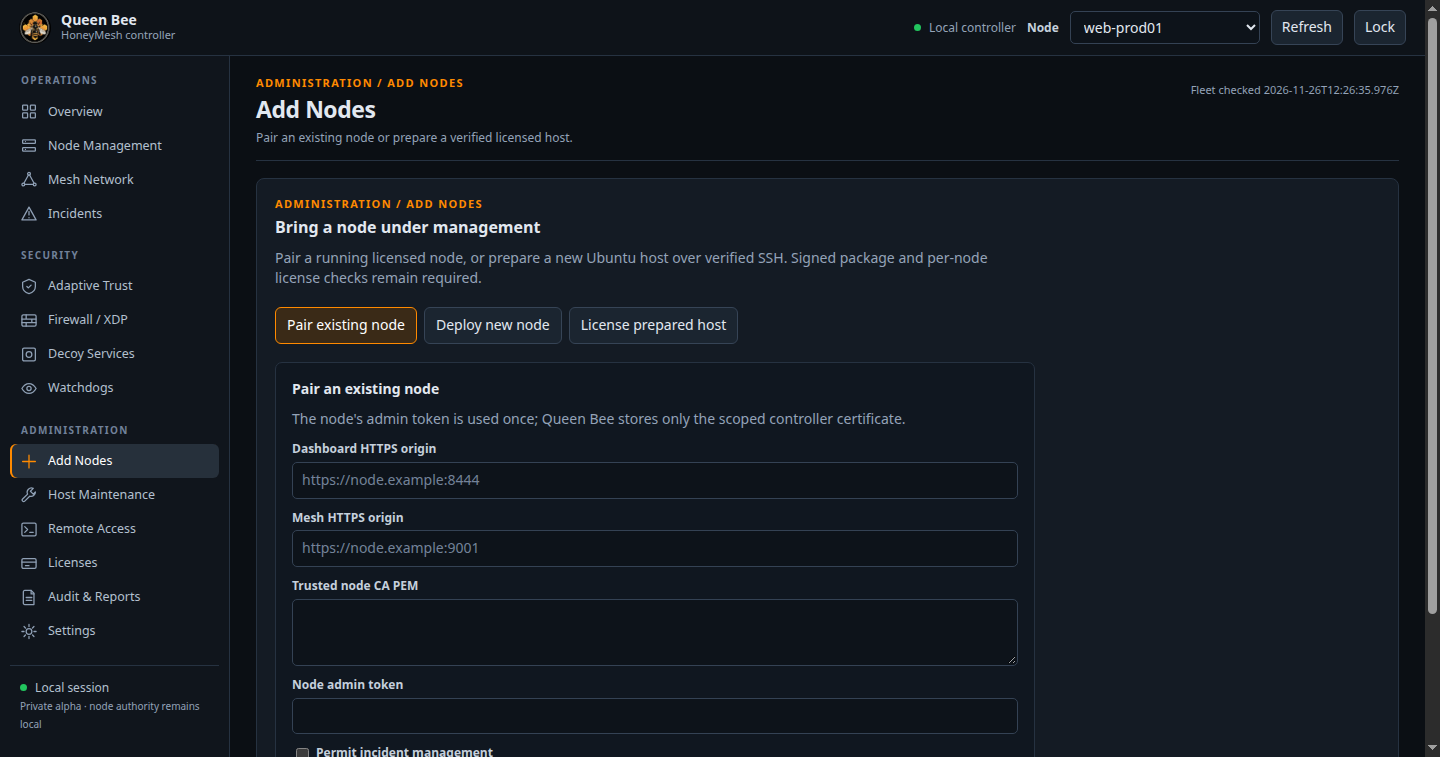
Verify a signed package, prepare a supported Ubuntu host over SSH, obtain its public fingerprint, install its own license, and start it in TEST before pairing.
The node private key stays on the host; each node needs its own license.
Check host update status, prepare a reviewed one-host update, or open an authorized root shell through the admin's local OpenSSH terminal.
SSH and sudo keep their own authentication; Queen Bee records action metadata.
New in private alpha.14 · opt-in emergency pilot
When a node is still reachable during a suspected partial compromise, an authorized administrator can ask it to drop incoming traffic on one selected HoneyMesh-owned XDP interface. One exact TCP management route stays available for investigation and recovery.
The node must be explicitly paired for owner-managed.v3. Every apply needs a fresh node preview and separate approval from the controller host's OS. The lease lasts 5–30 minutes; a reviewed release restores ordinary policy.
Reviewed path
Ingress on one interface only. Egress, other interfaces, and listening services remain. The current seal ends if Core detaches XDP. Keep independent console recovery.
Use it during real operator work
Suspect mesh peer
Select the exact certificate, inspect the case and provenanced grants, then hold reports or revoke that peer's trust under the node's policy.
Mistaken shared restriction
Trace the mesh-owned grant to its source and release that exact owner. Other valid local or Exchange owners remain independent.
Existing Linux server
Check the SSH host key, verify the signed installer, prepare a fresh node identity, license its public fingerprint, and activate in TEST.
Incident handoff
Save a bounded evidence snapshot and report with the case timeline, operator notes, response, and explicit verification limits.
Inside Queen Bee
These captures show the earlier alpha.13 private interface. The fleet and incident views came from an isolated three-node test; the enrollment form uses example fields. The new alpha.14 ingress pilot is described above and in its operator guide. These are screenshots, not a live customer dashboard.
Mobile view
The same isolated test case is available in the responsive interface. Sensitive actions still require the node's scoped authority and an explicit review.
Open full mobile screenshot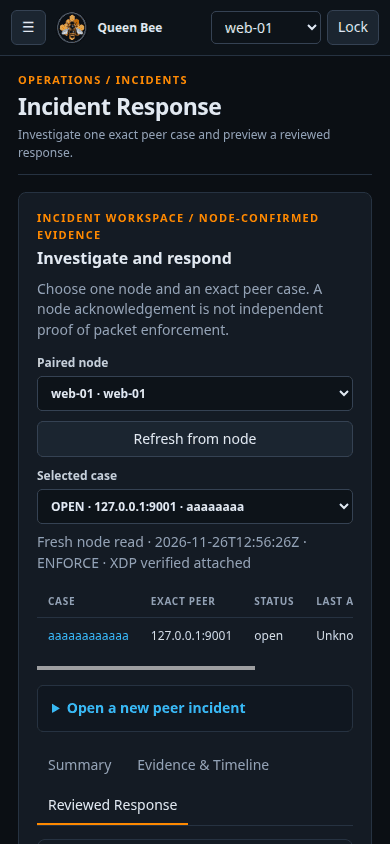
Adaptive Trust and authority
Queen Bee reports a node's current Adaptive Trust mode and uses only the controller scopes that node approved. Its incident actions target one exact peer and case. A received report does not automatically become a firewall command.
This alpha controller does not issue application grants, create autonomous posture holds, switch a node remotely into ENFORCE, or quarantine an AWS instance. Those integrations need separate development and qualification.
Continues if the controller is stopped.
Shows the node's answer, with a timestamp and verification limit.
Pairing grants a scoped controller certificate; it is not a mesh peer certificate.
Private evaluation
Buy a HoneyMesh 2.0 node license, then use the private link sent to your checkout email to download and verify the signed alpha.14 Queen Bee pack. You can prepare your first node over SSH before binding its public fingerprint. A refunded or disputed order cannot request new links.
To add nodes later, prepare each Ubuntu host over SSH in Queen Bee, review its public fingerprint, and buy the exact number of $45 node licenses in the Licenses view. Network Decode opens Stripe checkout and emails the fingerprint approval. Its delivery service signs the licenses; Queen Bee verifies them, starts the matching hosts in TEST, and pairs them. Card details and the license signer stay outside Queen Bee. The $5 monthly Hosted Exchange is separate.